There is a god with no name. He likes to go unnoticed. He smiles often. The artists think that he is rich; rich people that he is an artist.
He runs the city from the corners of a converted storeroom above a chicken shop somewhere next to the docks. The sign on the door says BRIDGE PROJECT in letters that were once golden. He chose the name himself, which should tell you something. He is always building bridges. He is obsessed with what’s in the other side but somehow not interested in crossing it.
He was something, once. Something with a title and a domain and a seat at a table that went on longer than you could see. He was the one that had the music. The keys to the skies. He does not talk about this. When people ask, he changes the subject so smoothly they forget they asked, and spend the rest of the evening feeling vaguely warm, like they’ve just remembered something good.
This is the last of his powers. A trick, really. The charm. That thing that looks like charisma from the outside. Charisma can be tuned, he knows it well. Charisma feels like mystery when is dosified with wisdom. Charisma smells like charm when is used as a tool. Charisma is suffered like annoyance when burns without any control. He still has the luck, too. Luck is not the same as fortune. Luck means things land. Fortune means they land well. He has never learned the difference. He thinks that he doesn’t want to know. But lately, in the midnight hour, he has doubted.
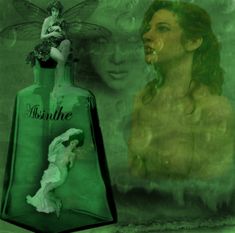
This is why he keeps the fairy in a bottle.
Vintage glass, the deep green of a tiny wine bottle held up to light, with a brass stopper he has to unscrew with two fingers. He found her in a market stall six months ago, sleeping in a tangle of her own wings like a moth that had given up. He paid forty pounds for her. The man selling her didn’t know what she was. Most people don’t. Most people see what they expect to see, and they do not expect to see this.
Her name, she told him, was something unpronounceable in a language older than the city. He calls her the Bottle. She calls him nothing at all, which suits them both. She does not make him powerful. That is important to understand. She makes him feel like he already is. He unscrews the stopper in the bathroom, just before midnight. She spills out into his palm, thumb-sized and furious, wings beating a frequency you feel in your back teeth.
You’re doing it again, she says.
“I know what I’m doing.”
That’s what you said last weekend.
“Last weekend was different.”
Every weekend is always different. It’s always different. Then it’s always the same. The train goes round and round for those who want to run, Mr.
He holds her up to the light. She glows faintly amber, like something expensive. Like something that, if you weren’t careful, you could get used to. She has big blue eyes, and red hair. She looks like a woman. A tiny woman. She has something unnerving about her. Her movements are unpredictable, a spasm, and then an elegant dance.
“Just tonight,” he says.
She looks at him the way only very small, or very old things can look at you. Like she can see the whole shape of you from outside, the way you can only see a building properly when you’ve walked far enough away from it.
Fine, she says. But I’m not watching.
She folds herself back into the bottle. He puts the stopper in. He puts the bottle in his jacket pocket, close to his ribs, where he can feel the faint warmth of her through the glass.Then he walks back out into the music, and he is the centre of everything, and he does not notice that the centre is not the same as the ground.
This is what it feels like, when the bottle is warm in his pocket.
It feels like before.
Not like a memory of before. Memories are thin, edges worn soft with handling. This feels like the thing itself. Like standing at the head of a table that goes on longer than you can see, and knowing, with the particular certainty that does not require evidence, that everything in the room is oriented towards you. That you are the thing the room is for. They are playing music for him. He has not felt this in a very long time and so he does not ration it. He does not sip. He drinks.
He is at the bar and then he is not at the bar. He is on the dance floor and he is brilliant on the dance floor, but he has always been brilliant on the dance floor, the dance floor is the one place in the world that has never lied to him. He is talking to someone, a man in a yellow jacket who is laughing, and the laughing feels like tribute. The laughing is owed, not earned. He is holding someone’s drink, someone else’s drink, he is telling a story he has told before but it is better now, because everything is better now, when the bass is a second heartbeat and he has two hearts, both of them right.
Here is what he does not see.
He does not see the man in the yellow jacket stop laughing three seconds before he should, and glance sideways at his friend.
He does not see the woman whose drink he is holding, waiting, her hand slightly extended, waiting, still waiting.
He does not see the way people make a shape around him. Not the shape of a crowd gathering, but the shape of a crowd adjusting. Making room, the way you make room for weather. For a storm.
He does not see any of this because he is not looking.
He is not looking because he already knows what he would see. He would see a room delighted by him. He has decided this in advance, and so the information coming back from the world seems useless. It registers as static. Background. The part of the painting that isn’t the subject.
He has, without knowing it, stopped listening.
And the bottle glows warm against his ribs, and it does not tell him. It never tells him. That is not what it does.
They find him near the back stairs.
Two of them, which is more than he deserves and less than he expected. They are polite in the way that people are polite when they have done this many times and have learned that politeness is faster. One of them touches his elbow. Just the elbow. The lightest possible signal.
“We’re going to need you to come with us.”
He starts to say something. He has, in his long and complicated life, talked his way out of situations that would have calcified lesser beings into cautionary tales. He has the words. He can feel them assembling, the old machinery turning over, the smile that has worked in seventeen languages and at least three planes of existence.
The man looks at him. Not unkindly. The look of someone who has already written the end of this sentence.
“Sir.”
That’s all. Just sir. And something in the word, it might have been the flatness of it, the way it contains no curiosity about him whatsoever, reaches through the warmth of the bottle and touches something cold.
He goes with them. Not because he decides to actually go with them, but because he is abandoning everything else.
The door they bring him to opens onto a side street. The sound of the club muffled now, half of a heartbeat heard through walls. He walks out. He has almost understood, the room have had enough of him.
The door closes behind him.
The bottle is still warm against his ribs but it is the warmth of something cooling, not something burning. He can feel the difference now. He could always feel the difference. He just hadn’t been paying attention to what he could feel.
He takes it out. Holds it up to the orange of the street light.
Inside, very small, very still, the fairy sits with her wings folded and her arms around her knees, and she is looking at him with an expression that is not I told you so, because she is older than that. It is something quieter. Something that has been waiting.
He unscrews the stopper.
She does not come out.
“Well,” he says.
Well, she says, from inside the bottle.
The street is empty. Somewhere a bus goes past on the main road, a brief tide of light and noise, and then it is gone.
“I made a mistake.”
You made the mistake, she says. The mother of all the other mistakes. You forgot that full and whole are not the same thing.
He looks at her. She looks at him. For the first time in weeks, they are looking at each other.
You can’t become who you need to be, she says, while you’re too busy performing who you think you should be. The room can’t tell you anything if you’ve already decided what it’s going to say.
He puts the stopper back in. Not to silence her. Just because she has said the thing and it is enough and the street is cold and he is standing outside a club on wet pavement with the smell of piss and cigarettes coming from somewhere nearby.
Not back inside. Not to the next door. The next room that will reshape itself around him.
Just the walk ahead. The long, unglamorous, and unceremonious walk.
He is surrounded by rubbish. Hesitation. For a moment, doubts. Fingers caressing the bottle. Then he throws the bottle away.
He starts walking.

